

Gonzo reflections on a local concert experience
“As a great man once said, it’s welfare for the rich and rugged individualism for the poor. If you can sleep at night licking their boots that’s between you and yours, but that type of thinking isn’t freedom. It’s mental slavery… Judge a man by how he treats the poor and those who he views as being able to do nothing for him. Don’t forget why Muhammad Ali said ‘I am America’ Remember the coal miners of Harlan County, Kentucky. I believe in what we can be. Ride on.” – Charley Crockett Feb. 6, 2026
I soared into Mission Ballroom feeling 12 feet tall, with a new pair of Dan Post cowboy boots. It was my first time in raised heels, and so far the two-inch boost was pairing nicely with my prior ingestion of a highly potent tab of locally brewed LSD and half a fifth of Old Forester—two tools strategically selected to heighten an evening of good music and straight reporting.
Charley Crockett was in town and, more immediately, somewhere backstage prepping his mojo, probably sipping a fine liquor, most likely whiskey or tequila. In country music, whiskey is the industry standard, but, given Crockett’s roots, I figured whiskey only a 2–1 favorite.
San Benito, Charley’s birthplace, lies in the southernmost reaches of Texas, only 20 miles from the border and tucked in the eastern edge of the Rio Grande Valley. With a population of 25,000—90 percent of whom are Hispanic—I figured 2-1 may even be too generous to the brown stuff. But considering Crockett’s affinity for Waylon Jennings and the whiskey-soaked lyricism of his longtime opener Vincent Neil Emerson, I was confident in my projection.
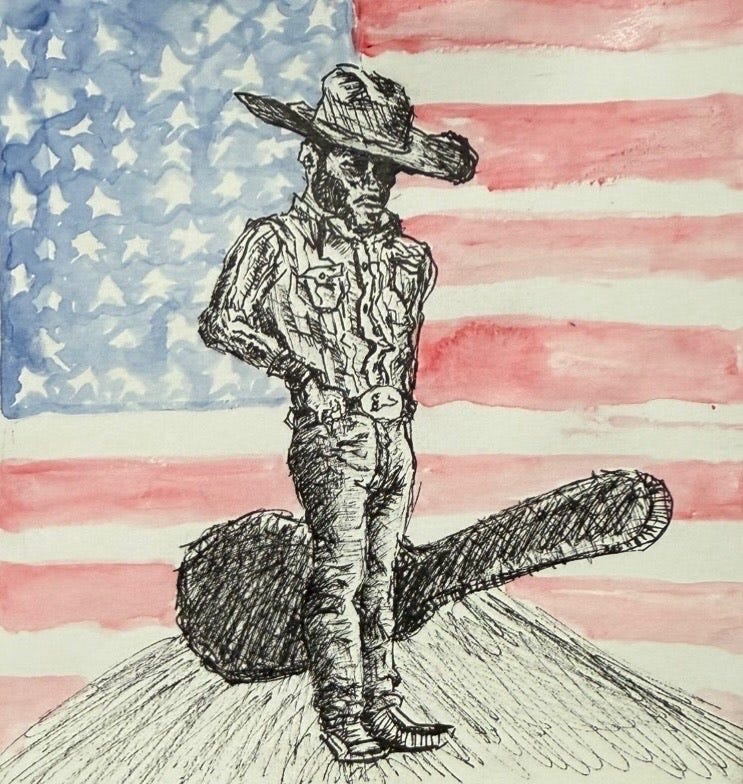
The opening act was a colorful mirage of long hair and Western sound. Denver’s own Extra Gold oozed with authentic swagger, putting on a cosmic performance of country rock and introducing a synesthetic blur of sandy rust into my headspace.
Yes, I was now pleasantly twisted. Steadily tuning into the familiar frequency of an onsetting acid trip, but classically tasked with fending off an onslaught of inappropriately philosophical thoughts. I began to reflect on the beauty of the moment, and how all the previous variables of the past two decades had stationed me here, just moments away from the presence of Charley Crockett, and under the influence of this artisan neuro-potion. To think that without a beer here, or a dose of Golden Teachers there, I might be at a Morgan Wallen show…God bless.
The lights dimmed and the atmosphere thickened with the collective anticipation of a full house — a permanently exhilarating moment familiar to all who frequent live music.
Charley now stood square with the mic, seemingly chiseled out of stone, his jaw bearing an impossible density, his legs carved trunks of dark indigo.
“How we doing, Denver?” he boomed from the speakers with grand bravado. The show was on.
Time seemed to slow as the anticipation became palpable.
Crack! His voice shattered the tension, like a bottle to pavement. I was jolted from my hypnotic reverie and hit with a wave of impossibly full sound. The lyrics “been in Kentucky too long” ricocheted around the room. I ducked swiftly to avoid being hit.
The band was tight, each member contributing their own unique zeal and operating with a proud composure. Crockett floated across the stage with divine cadence. I was struggling to grasp what I was seeing. Music can look like this?
Things were heating up. Crockett went backstage momentarily. His band, The Blue Drifters, filled the lull with a smooth instrumental. On return, Charley brandished what appeared to be a piece of alien weaponry. A brief surge of panic overtook me as I envisioned him going rogue,
popping heads, and reducing the mob to jelly via bonemelting laser — through later research, I identified the instrument as a JERRY JONES ELECTRIC MASTER SITAR (GREEN CRACKLE).
I snapped out of it and drowned the fearsome image with a long hit of bourbon from the brown leather flask tucked at my hip, looking to the stage just in time to see Charley swill two shots of a clear liquid. Tequila, or maybe Mezcal, I reasoned…The boys played on.
I looked right, checking the status of my three dilated comrades who had accompanied me here. To my dismay, I found them being cajoled by three randy-looking older women. I was far too loaded to attempt a rescue mission, so I figured them dead meat and turned my attention back to the band.
Thwack! Directly in front of me, a lumpy middle-aged man hit the floor hard. I stared in disbelief. He was swiftly helped up by a nearby gentleman. The lumpy man teetered momentarily, then plummeted back to the gray concrete, this time face-first. The shock subsided, and I was now fascinated by the poor fellow. Had Crockett struck him with a spell? I knew he had lived in New Orleans in the early 2010s; it wasn’t impossible that he had picked up some Louisiana voodoo along the way—or maybe he had been hit by a materialized lyric.
“They call me the Muhammad Ali of country music.” – Matthew Charles Crockett, Feb. 6, 2026
Damn right they do.
Charley Crockett is among the few public figures today who fear the reality of leaving truths unsaid more than the potential repercussions of challenging the crooked. It is with a deep understanding of this country, acquired through decades on the road, that Crockett calls spades spades.
With an unflinching boldness that would make his disappearance no mystery, Crockett stated in February, “They keep saying I’m a cosplay cowboy but they love a cosplay president… The President is a grifter who bankrupted six casinos. That’s pretty extraordinary considering it’s a rigged business in favor of the house… Last time I checked Elon Musk was an immigrant from South Africa, but there he is standing in the White House buying our elections. Let’s deport his ass and send Peter Thiel back with him since they both openly believe in a post democratic society where men of their class are above the law. Forgive me if I have a problem with a 34 time convicted felon running this country when I lost the right to vote or own a weapon for years over marijuana. As long as you’re hating the oppressed and loving your oppressor you’ll never know why our generation is poorer than our parents and grandparents… I truly believe this isn’t a left or right issue. There’s something else happening here.”
What’s that “something else,” Charley? A cult of socialites, politicians, and business tycoons running the world and raping children? No, that’s crazy talk. You’d have to be an acid freak to believe something like that…
It is with composure, conviction, and a textured past that Crockett speaks in pursuit of justice, not agenda. He has cemented himself amongst the rare few who do not rest idly in fame, but use notoriety to pursue greater change.
He once wrote, “‘Charley, why do you put out records so fast?’ Because the suits go on forever, and prize fighters last a short time. Cattle kings own the spread. Cowboys only work it. Look around. Politicians take money from the rich and collect votes from the poor, while promising each protection from the other. That’s what I call a conflict of interest… If I did it their way, you’d never even have heard of me. Fenced in, sold off, and played out. All for a ‘Dollar A
Day.’”
You’ll have to work hard to decode these themes within his music, but I believe it won’t take long for Crockett to be producing anthems of unity and rebellion like his predecessors Woody Guthrie and Bob Dylan, both of whom wielded music like a blade—rallying the masses and cutting conformists at the knee.
The range of references embedded throughout Crockett’s writing makes it clear that, as a high school dropout, he is better read than most PhDs. Sourcing inspiration from a complex array of individuals, ranging from Elie Wiesel and Martin Luther King to heroes of the old West and biblical scripture, it is apparent Crockett never intended for “successful country singer” to be his final destination.
A man of mixed heritage, brought up by a single mother in a trailer park, who did not wear shoes until the age of 10, he picked up two felonies in adulthood but continued to pour his faith into himself and America. His story represents the greatness that exists within the bones of our country. An American hero, a title you can’t buy—even with a small loan of a million dollars.
To epitomize this crudely dense assessment, here’s one for the road—from a man far more articulate than I:
“An institution that should always fight for progress and reform, never tolerate injustice or corruption, always fight demagogues of all parties, never belong to any party, always oppose privileged classes and public plunderers, never lack sympathy with the poor, always remain devoted to the public welfare, never be satisfied with merely printing news, always be drastically independent, never be afraid to attack wrong, whether by predatory plutocracy or predatory poverty”
— Joseph Pulitzer, May 10, 1883, in an editorial upon becoming the publisher of the New York World