

After arranging the interview, I discovered that artist Joshua Porter was practically my neighbor. I’d been following his artwork online for over a year, and now, after walking a few blocks to meet him at his Cap Hill apartment, I found myself in his living room. We started chatting, as strange ambient music sounded from an old CD stereo by the kitchen.
Denverse Magazine: How would you classify your art style? It seems a little more industrial, similar to H.R. Giger, but with more of a slice-of-life focus.
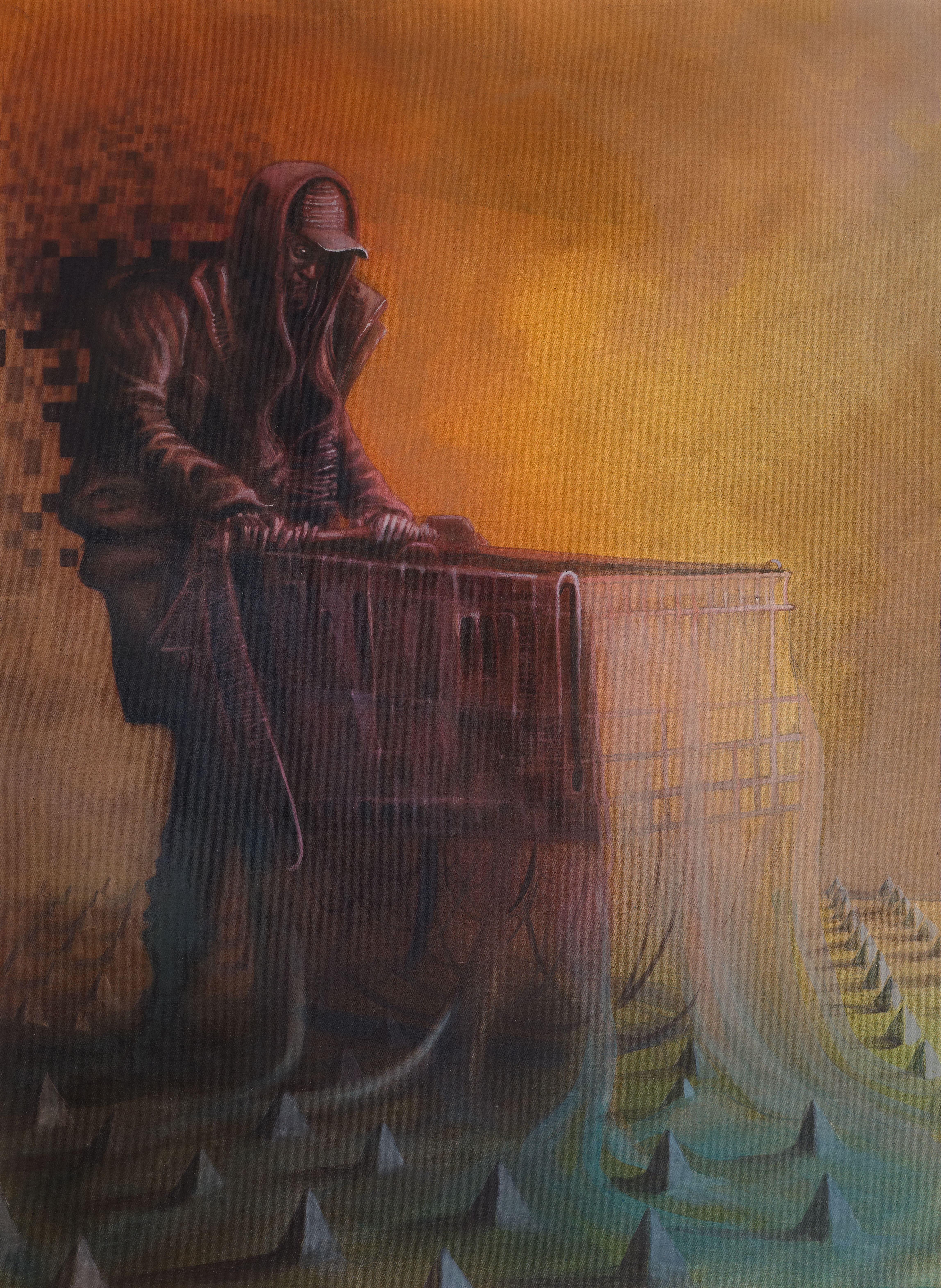
Joshua Porter: I think it would be classified as dark surrealism, but that’s pretty broad. Giger had his own message. But he did always strike me as someone who made this very intricate, very dark and beautiful imagery and attached a commentary that was a little more inward, I guess. It was more about introspection, which I certainly touch on. There’s a Polish artist Beksiński, who’s also a huge influence on the imagery and technique that I’m using. His work was post World War II, you know, so he was trying to express the atrocities of war. The post-apocalyptic imagery is kind of tied in with that.
I look at artists like that and their work as being like language. Like, they’re speaking a specific language, and how can I use this language to communicate something else? Something I’m observing in the world, or how other people see the world. A kind of interpretation. You know, I’m staunch public transportation, I like try to interact with the community as much as I can.
I really like to live in a city. I work kind of out by the stadium, and there’s the old factories, things like that. The outskirts. That industrial side of things.
DM: What, what was it originally about that dark surrealist art style that drew you to it?
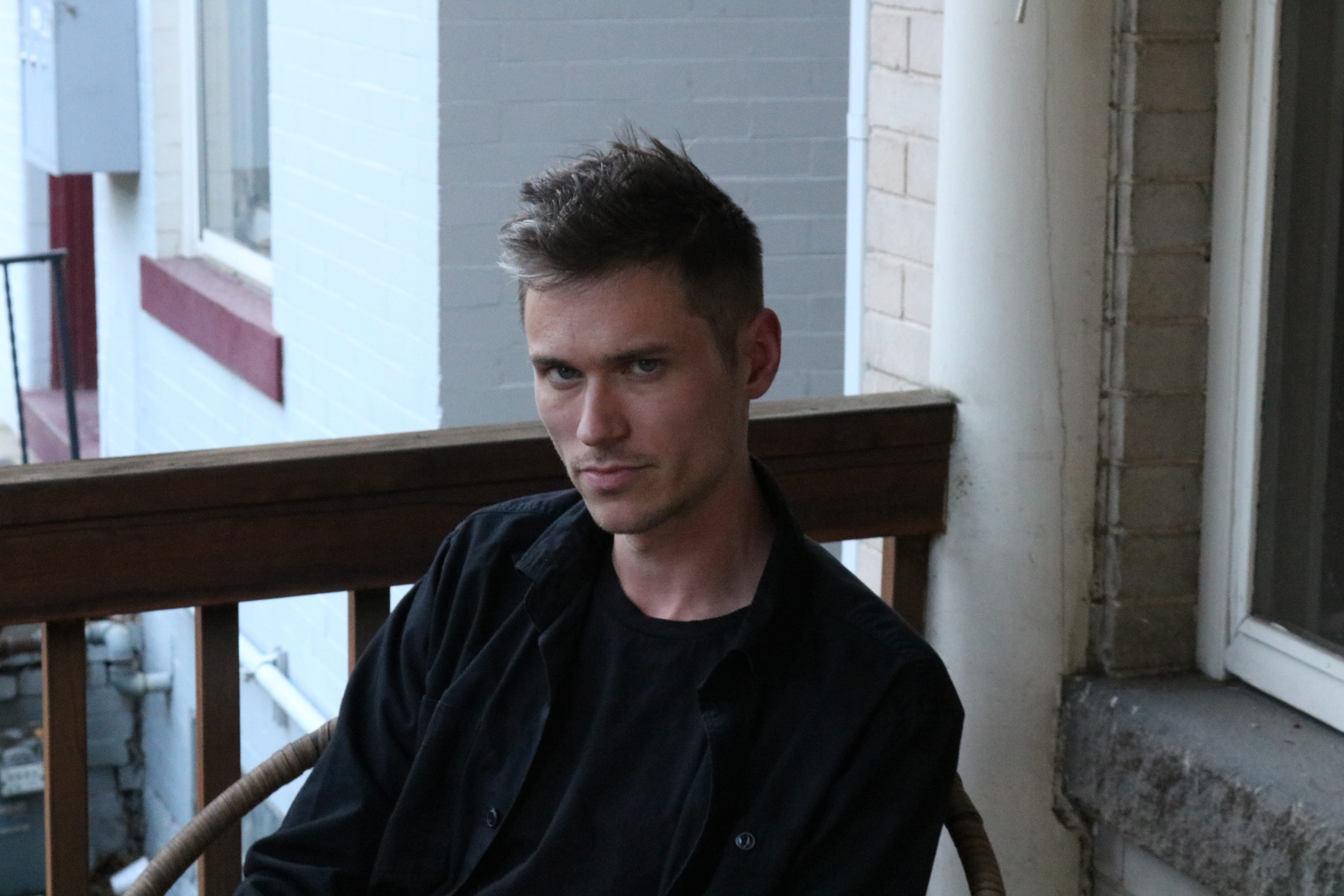
JP: So I have a background in addiction and recovery. And I’ve sort of always felt like I lived on the fringe of society. Outside. It’s sort of an alternative lifestyle to be in recovery, I guess. To have gone through recovery. And coming out of that world, seeing both sides. And then I have a continued interaction with people from all walks of life through public transportation.
There’s more of a connection to a side of humanity that people don’t access. You know, I think a lot of people tend to go from car to work to car to home. You know, it’s sort of a bubble. To be out on the streets and interacting with the people you encounter there and other people that are commuting, I don’t know, it feels like there’s more of a pulse there to me. It’s something I try to capture.
I think a lot of times my work comes across as kind of intense. And very dark. But I do want there to be this element of humanity and beauty within, you know? It’s like, they’re terrifying and horrific things. It’s sort of an exaggerated American Horror Story. And I think it does sort of require an empathetic lens to get the whole picture of what I’m trying to say.
DM: Hence the elements of the everyday. Is this common in the dark surrealist genre?
JP: As far as I know, that is the unique edge I have found with my work so far. Through Instagram, I’m connected with a bunch of different dark surrealist painters and sculptors. We have sort of a group chat where we share work and talk about what we’re doing. You know, a lot of people who are using a similar aesthetic tend lean towards, like, I’m making something scary, just terrifying to behold. Like, it’ll be this gruesome visage, you know?
And it’s like, okay, but what does it communicate? What does it say? And if the answer to that is that it’s just supposed to be scary for the sake of being scary doesn’t feel as powerful to me.
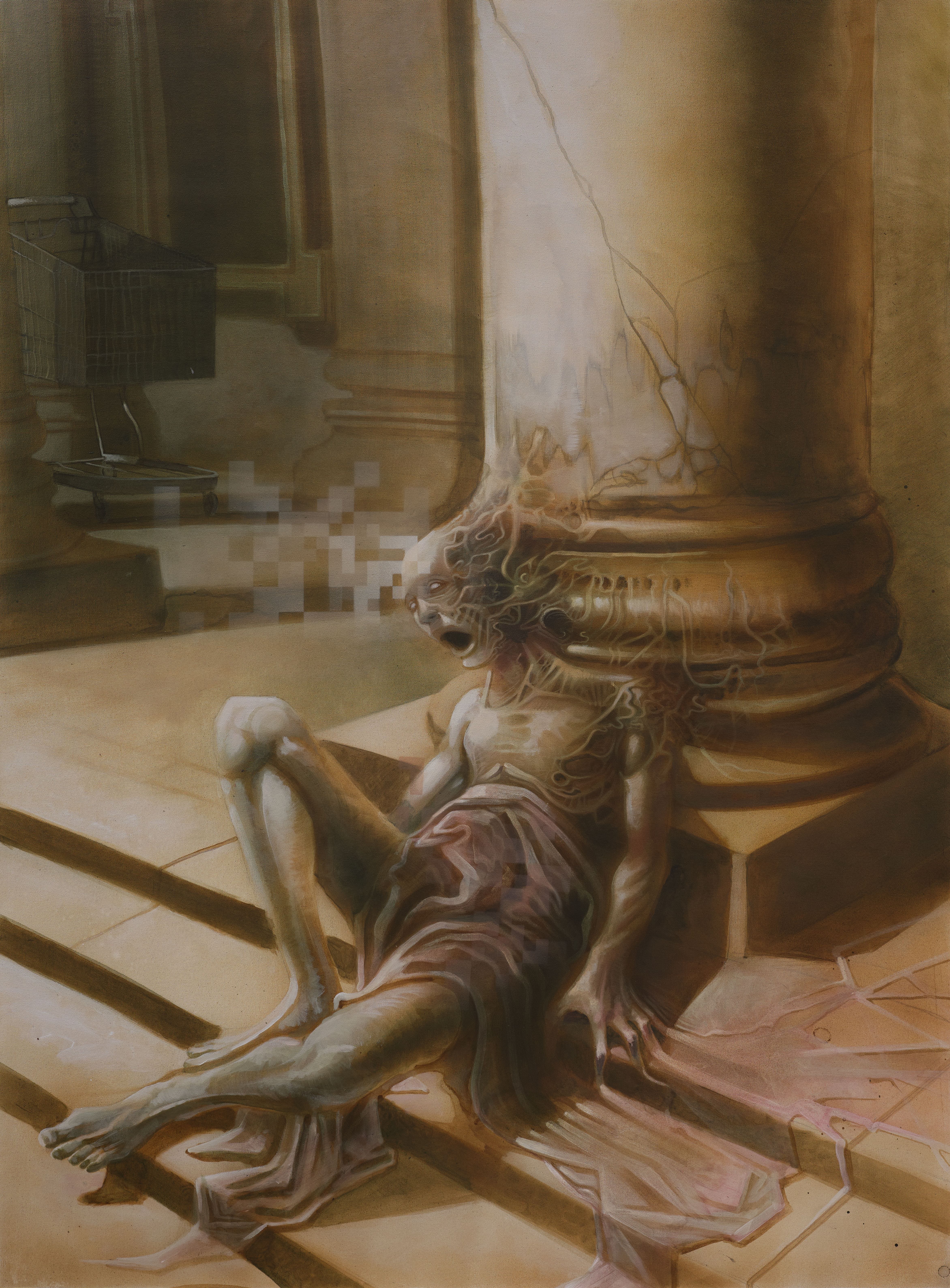
I guess I look at the world around us, and I’m like, there’s plenty of things that are terrifying and that seem insurmountable that sort of become everyday as you’re passing them by. Different people in different situations. Different corners of the world we live in. There’s enough there to amplify that and touch on that with those same aesthetics. And I think that it’s a lot more effective that way. It has something to say.
It’s like realism, which was sort of controversial at the time for depicting working class people in working class situations. The grit, the reality of what life like that was. As opposed to romanticism, where it’s like elites and upper class society depicted as these larger-than-life beings, in almost fantastical situations, you know?
I like to take that kind of approach, but turn it up a few notches, use the hyperbole of surrealism to push that sort of communication even further. Take people from different parts of society in different situations, show the “reality” of that, but amplify it, make it more visceral. I feel like we need now to actually feel a sense of shock and horror at the reality of these things.
DM: What are some these things? What do you want to present as horrifying?
JP: I do think there’s a tendency in art to ask the question, Are you qualified to make a commentary on these things? Maybe that’s a personal feeling of my own, but, stemming from that, I do touch a lot on addiction, recovery, being locked in that cycle.
DM: Do you think that you have to be qualified to depict those things?
JP: Not necessarily, but I do think it gives you the mindset to appropriately approach those things. You have a sensitivity, perhaps, which honestly, I do feel like I push sometimes. But I try to approach things with a level of reverence where I can. Homelessness is a big one. The houseless situation that we see more and more, which kind of goes hand-in-hand with addiction a lot of the time. This lack of a societal safety net for pretty much everybody after a certain point is horrifying. And it’s something that can potentially be fixed, you know. But some people’s reality is jarringly different from what you and I experience, and I want to shine some light on that or bring that forward. It may be kind of uncomfortable or terrifying to be told, but it is reality.
DM: When did you start painting these figures or incorporating them into your work?
JP: You could probably pull it up on Instagram and find an exact date.
DM: Oh, so you’ve been active online with your painting all along?
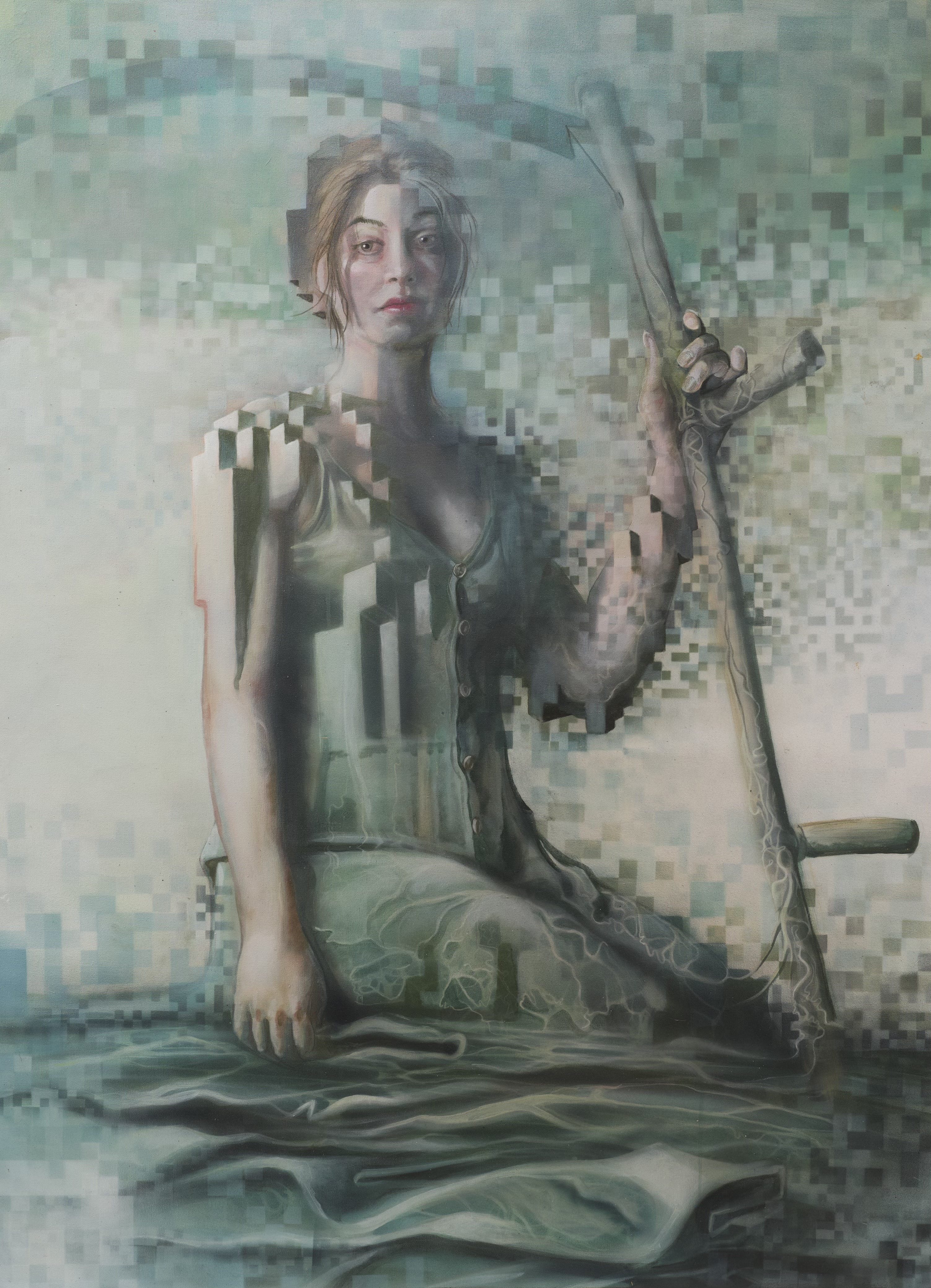
JP: Kind of. I’ve only really been painting and taking it seriously for four and a half, five years now, but I do have a background in traditional illustration and drawing, which is mostly self-taught. I never got a degree, but I did go to college for two, three years.
I do think of it as being a lot more like self-taught, like, what do I know how to do, and how can I use that to create the kind of things that I want to create? My painting is all the things I know how to do, but I think it also sort of exists as shadow work, like an exorcism of some negative energy. It’s good way to process things.
DM: You never got that through illustration?
JP: No, it doesn’t quite hit the same.
DM: Why?
JP: I don’t know. Maybe it’s the time investment or because it’s sort of pulling out all the stops. Like illustration is almost… I think of it as being the more marketable version, so to speak. Fine art or painting is the expression of the self without regard for necessity. People have different approaches to this, but for me, it’s very much like, I’m going to make this because I feel like I have to paint this. There’s a spiritual side to it that’s important to be fulfilled. More so than, say, I am making this thing because it’s marketable and this is what people want. Or I’m making this for a specific purpose. It is useful to know how to do that though. I’m doing an album cover for a Denver band right now.
DM: By the way, what’s this music you have on right now?
JP: Oh, it’s Klaus Schulze. He’s an electronic composer. This is the last album he made before he died. [He pulls out the CD case]. Yeah, it’s based on Dune. If you can pick up a copy, I would recommend.