Lazuli Bunting: My Search for Meaning. And Birds
by Adam Cayton-Holland
Of all the many reasons people love to birdwatch, I fear mine may be the worst. Sure, you have your life-listers, your weekend enthusiasts and backyard birdfeeder heroes; I have thoughts and theories on all of them. As does every birder. We are a surprisingly opinionated group. But regardless of what you think about the various species of birder, I might be the most insufferable.
Because I’m looking for meaning.
Not in every bird I come across. A pack of bushtits on my morning dog walk doesn’t turn me into a philosopher. Sometimes a bird is just a bird is just a bird. I know that. But every avid birder knows the special sightings. The ones that loom large in your archive. The ones you can recall in vivid detail—the temperature, the season, the actual feel of that place in time—no matter how many years go by.
Which I so appreciate. I don’t get those clear snapshots much anymore. I used to. I used to be the guy with the impressive memory, the writer who could remember every detail. No more. Recalling even basic life events has become difficult. Ask me what I did on my birthday last year and my jaw slackens, my eyes unfocus in a sort-of stultifying confusion, until I come to resemble, I imagine, a man very recently kicked in the head by a horse.
Call it middle age.
But a good bird encounter? I can paint you an entire picture.
Like the nightjar. The one I kept seeing whip across my front yard when I was least expecting it. It would shoot by at chest height, then veer up and over the neighbor’s roof with breathtaking stealth, like a daredevil fighter pilot.
Only a raptor could move like that. Some small bird of prey, surely. A kestrel, perhaps? But you don’t see them much in the city. A merlin? Dare I dream, a peregrine falcon?
Every birder is familiar with this internal calculus. But I couldn’t come up with a definitive ID.
The mystery bird darted by, low again, but instead of veering over the roof, it tore across the street, landing in a neighbor’s garden bed. I ran over, and there it sat on the ground, almost perfectly camouflaged in the soil, this strange bog frog. The name came to mind instantly: nightjar.
Not uncommon in Denver, but nocturnal, often clumped against the branch of a tree in the day, totally hidden. I had never seen one up close, and yet this one was showing itself to me. Again and again. A cursory search of the lore around the bird proved ominous. They can be harbingers of death. Spirits aligned with witchcraft. This sighting was during the height of COVID; it wasn’t hard to interpret the bird as an omen of something terrible.
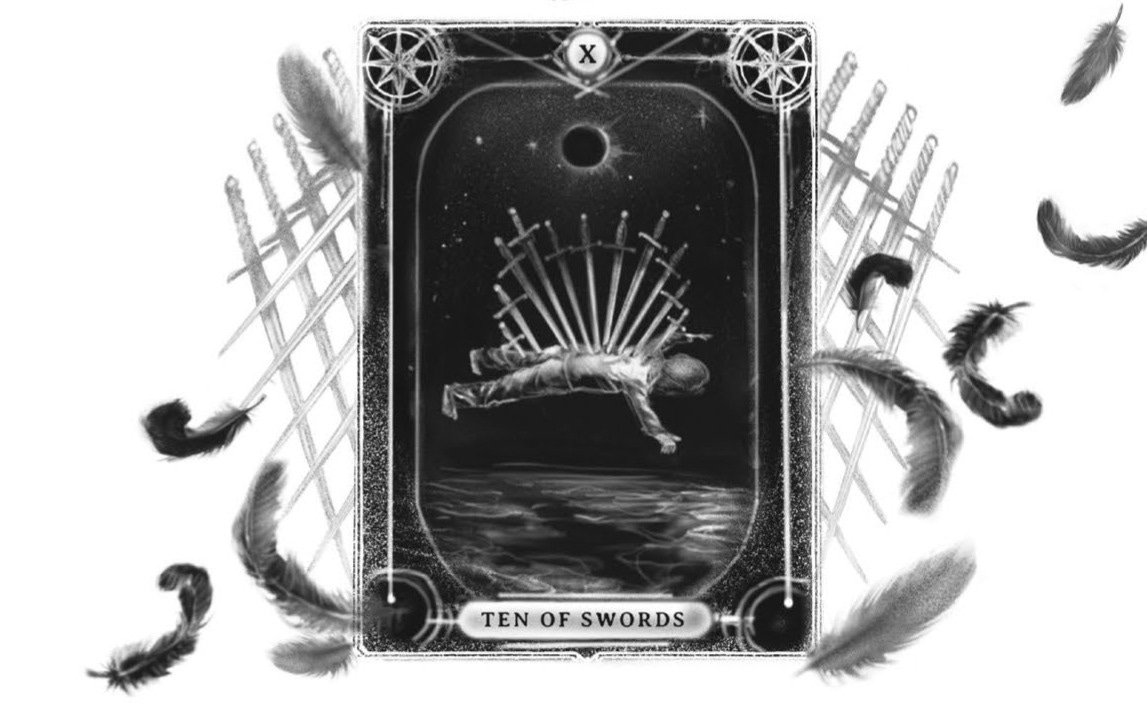
Bird mythology is like fortunetelling: flexible; you take from it what you want. Once, in New Orleans, outside the St. Louis Cathedral, I had my fortune read by a strange and dazzling woman who unearthed the most macabre card from her deck—a man stabbed by dozens of swords—then assured me it was a good sign. So, I went with it. I didn’t panic.
Ditto the nightjar. I saw it as something to be wary of, but it also felt indicative of the times, reflective somehow. During a global pandemic, where death lurked around every corner, of course I was seeing a nightjar. It wasn’t scary, but it felt, and feels, like an appropriate symbol. An ominous visitor.
Owls are also often interpreted as portents of doom, but once I saw a barred owl in Athens, Georgia, that set me on a more hopeful path.
I was on a little comedy run through a handful of cities in the South. My newly pregnant wife joined me. While in Athens, we got a call from our doctor with some alarming news about our unborn child. Nothing dire, but a reason for concern. A prescription was called in; we had to start progesterone shots immediately. It was our first child, we were terrified, as is anyone who has gone through a pregnancy. It all feels so fragile.
Shaken, we went out for brunch at some decadent spot. Biscuits, waffles, fried chicken, grits. They literally had a slice of birthday cake on the menu. For breakfast. Jesus Christ, the South. Slow down.
A waiter told us that the trail behind the restaurant led to the iconic railroad trestle featured on the back of R.E.M’s album Murmur. We set out for it, and after a few minutes we found ourselves completely alone in the woods. Then we saw a flutter across a ravine, which crystalized into a barred owl landing clumsily on a branch and staring at us, neither scared nor particularly interested, just there. In the open. For us to stare back at.
Everything was quiet, and still, save for a faint breeze through the leaves. Pure magic. After 24 hours of handwringing over our child, that owl snapped us out of our downward spiral. It calmed us because it felt bigger than us, like that barred owl was put there to tell us that our son was going to be okay. It may have been a leap, but a leap was what we needed. And our son came out absolutely fine.
As powerful as these encounters felt, as important to me as they were and are, lately I’ve started to question my search for meaning in birds. I wonder if it’s because I’m becoming a better birder, or at least, a more frequent one. The more I bird, the more these incredible encounters occur. And when something becomes more common, sadly, it becomes more routine. Less meaningful. Maybe this is the devil’s bargain.
This summer, there was something promising, a prize bird in season, the lazuli bunting, a sparrow-sized songbird with bright, cerulean plumage. Couple that with a white wing band and an orange breast and you got yourself one knockout bird. The males anyway. I’d seen one before, in Malibu Canyon State Park, but never in Colorado. And this summer there were reports of them everywhere. Yet I kept missing them.
My wife was having better luck. She saw them regularly, on her frequent trips to the dog park, out by Cherry Creek Reservoir. So, I joined her one day, before summer turned to fall and the lazuli buntings migrated away from their breeding grounds in the American west. It was a Thursday, and it just so happened to be the thirteenth anniversary of my little sister’s Lydia’s death.
Lydia and I used to bird together, back in my early years of ornithological interest. And hers. She went to Colorado College and designed her own major: Animal Behavior. It was a combination of biology, zoology, and anthropology, but it also allowed for a wider range of less scientific, theoretical study: mythology, literature, art. It was perfectly her.
One day, Lydia and I headed to the middle of nowhere, out between Colorado Springs and Pueblo, way east off I-25, and birded together for hours, an assignment for a class she was taking at the time. We sat beneath a giant cottonwood together and catalogued every bird that came within 50 yards of us.
I still can’t think of a better way to spend the day.
She was on my mind when my wife and I set out see a lazuli bunting. And as we got out of the car and headed into the dog park, in my head, I thought to myself, come on, Lydia. Show me one.
I don’t know why I ask her to do things like that. To show me a bird. To give me a sign. It seems unfair. I should leave her alone. I know that. But sometimes still, I’ll reach out.
I’m not alone in these sad requests. Other people I’ve talked to who have experienced loss tell me they occasionally do something similar, their equivalent of searching for a sign, a message. We’re so gutted with grief, and the human world offers nothing to explain it away. So we turn elsewhere. The natural world. The stars. Birds. And even if the meaning is opaque, when you find something, when you get even a whisper of it, it’s so powerful you want to collapse right there on the spot.
I remember when Lydia died, I kept having these wild encounters with red-tailed hawks. Too many to recount here, but they were eerie and frequent. My mother experienced them too, and when we realized the same thing was happening to both of us, it felt undeniable that Lydia was there in those moments, that she was reaching out to us, trying to communicate, trying to help us grieve.
But I’m a better birder than I was then. I now know that some of those hawks we were seeing were not, in fact, red-tailed hawks; some of them were Cooper’s hawks. Hawks are difficult to identify, especially when not in flight. We were most certainly having uncanny encounters with red-tailed hawks, but we were also having them with Cooper’s hawks.
Learning this took the wind out of my sails. It poked a hole in the profundity of my mourning experience. Did the birds matter? Did any of this matter?
I wanted to ask Lydia.
But I knew what she would say. She was a Doolittle, the mama of so many pets, an animal behavior major who loved creatures more than people. Whenever I asked her to decipher meaning in something I saw or read or heard about she would always respond with the same answer.
It’s foolish to anthropomorphize.
And while that statement may seem cold, clinical even, she never meant it that way. This wasn’t the statement of some lab coated technician, dismissing animal behavior as nothing more than science. If anything, it was the other way around. No one saw more wonder in animals than Lydia. She believed animals more capable of thought, emotion, feeling, expression than humans could ever hope to comprehend. She theorized animals were operating on a level far beyond our capacity to decipher. When it comes to what animals are trying to tell us, I think Lydia would agree, we really have no clue at all.
In that light, maybe it’s silly to think any bird encounter means something profound, to think that birds are trying to show you something, to tell you something. But maybe it’s just as silly to think they aren’t.


