

One of the city’s most prolific graffiti artists is a woman with a handle of pain.
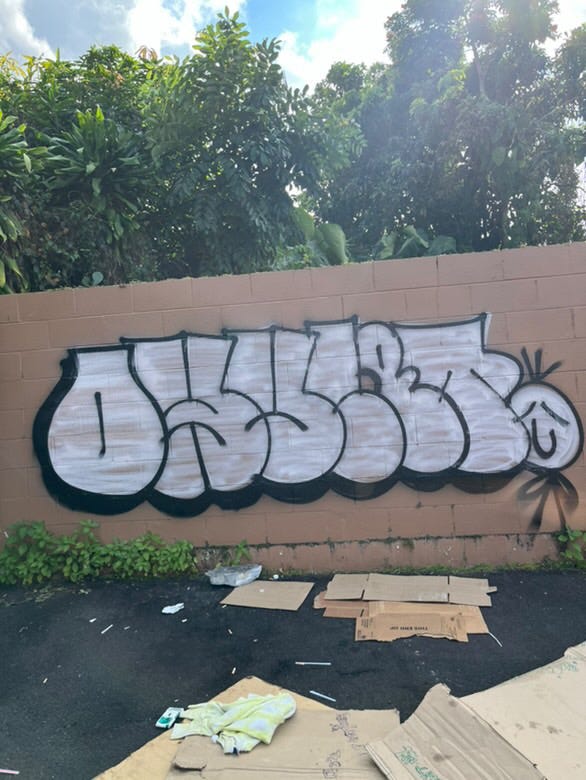
The voice on the line shocks me. For weeks, I’d been tracking down the person responsible for a message I couldn’t escape. I saw it in Baker. I saw it in Cap Hill. Behind a high fence rolled with razor wire, in the upper part of RiNo where the mural-rich neighborhood relapses into grit, there it was: OHURT.
A message. But also a name, a persona. Self-promotion is rampant in graffiti culture. The more your name is “up,” the better. As I’m later told, “It’s like marketing without a college degree.” Graffiti artists compete for wall space the same way corporate brands muscle for airtime—one of these isn’t trying to sell you something, and that’s the one that’s illegal.
So when I started exchanging messages with Ohurt, it was a criminal I pictured—an image my mind and the world’s penal systems mostly code as male. But speaking to me late at night, from a blocked number, is the bright voice of a young woman. She laughs at my confusion and agrees to let me tag along.
A month later, Ohurt and her husband pick me up in an SUV en route to zones of vandalism. It’s about midnight, and I’m wearing dark clothes, as instructed. The weeds in the planters outside my complex bend with late winter gusts. I feel the chill enter my fingers and worry I didn’t layer properly, as instructed.
“Are you excited?” Ohurt’s husband asks me from the driver’s seat. The whole sequence makes me feel like a kid. In Ohurt’s world, that’s what I am though—despite her being about a decade my junior.
Ohurt is in her mid-twenties, and there’s absolutely nothing about her appearance that strikes me as tough. As she turns her head, I notice a bow in her hair, white ribbons falling down her back—ostentatiously girlish, the kind of thing you’d see a fourth grader wear on a field trip to the state fair.
“Yeah, I’ve never done anything like this before,” I admit.
We joke a bit about the risks of journalism. The SUV and the good humor of my subjects put me at ease, but I’d sent screenshots of my interactions with Ohurt to a close friend before heading out, just in case. “Writing is a contact sport,” Ohurt’s husband had said after joining us on that first phone call. In this context, “writing” meant graffiti, with artists referring to themselves as “writers.” By “contact sport,” he meant that violence is always a possibility.
We’re heading south on Broadway, on our way to fix a diss. A local crew (a band of graffiti artists) has been messing with Ohurt’s tags, sometimes crossing her name out, sometimes writing their handle over hers. Despite its illicit nature, graffiti is rife with protocol. It even appears to have its own class system. If someone has already tagged a spot, especially if the artist is established—and not a “toy,” a derogatory term for graffiti newbies and dilettantes—it’s considered an insult to tamper with their art.
In this case, a crew using the tag “KE” (short for “Kill Em All” according to Ohurt) has sabotaged Ohurt’s tags on some shipping containers off Santa Fe. KE is a bigger and more intimidating operation, Ohurt says, with dozens of people in the crew, and they’re not just claiming walls as canvas; they’re marking territory.
“A lot of writers come from gangs,” says Ohurt. “But I don’t think you have to come from a gang to do graffiti.”
Ohurt comments on how her background makes her an anomaly in the culture. First, of course, she’s a woman. While female writers do exist, Ohurt says, it’s rare that they’re involved with the riskier streetside vandalism of tagging billboards and rooftops. Second, she’s middle class. Her father is a local business owner, and she doesn’t have a criminal background beyond her current endeavors. Third, she’s an independent artist—not part of a crew. And, according to Ohurt, this is what has led to the beef with other artists in the area.
“If you get up enough, crews will ask you to get with them and throw them up so that they’re more seen,” Ohurt says, explaining that she’s declined every offer she’s received. Ohurt has been writing for about four years, but, after a skateboarding accident where she broke her arm and her jaw, her tagging routine became constant and her work began catching the attention of established crews.
Up to that point, Ohurt had been using graffiti to express inner pain—her battles with anxiety and depression. “It was definitely an outlet to feel…seen,” she says. However, with her jaw wired and her arm in a sling, Ohurt found even more reasons to turn to the streets for therapy, and her tagging accelerated to a breakneck pace. “We’d be walking probably five to ten miles a night in the summer. For like six hours. Till the sunrise sometimes,” says Ohurt.
It wasn’t long before Ohurt’s tags were everywhere, and local crews began calling on her to work with them. “It’s like a sales company hiring a really good marketing agent,” her husband explains.
However, Ohurt wanted to remain independent, and it was when she began rejecting the advances of these crews, she says, that resentment began to build and she started receiving threats online.
“There’s a lot of politics in the graffiti world. The threats are crazy. They go deep,” says Ohurt, claiming that she has received pictures of guns from taggers who think she’s edging in on their turf. Most alarming was a recent incident where a picture of her in a bikini circulated among members of a crew.
“It got scary,” Ohurt says. “Graffiti is supposed to be really anonymous. But these people got pictures of me and were sending them around.”
And while the politics and the threats haven’t stopped Ohurt from writing, they have had an impact on the way she views graffiti. “I got involved way more than I wanted to be involved,” she says. “I didn’t want to be this known, I guess. It just kind of happened. It was really compulsive for me. But I never expected to piss so many people off. It was such a joy for me and felt so special, and then when other people got involved, I just didn’t want to paint anymore.”
We pull up behind a car wash. Ohurt and her husband take a telescoping metal ladder, along with a few spray cans, out of the back of their car, and we walk up an embankment until we reach an array of derelict shipping containers. Gravel crunches beneath our shoes, mixing with the soughing of sparse late-night traffic on the road behind us.
“Have you ever encountered another person tagging while you’re out?” I ask.
“It does happen,” says Ohurt’s husband. “Most of the time people will just ask you what you write and leave you alone. One night we ran into three guys from this group called RGK, but that was really chill. But then later, as internet politics started to unfold, they reached out to us and said that if they ever saw us again, they’d take our paint, which is like a big diss. You have to fight for your paint.”
“This is people’s life,” adds Ohurt. “It means everything to them.”
“Some people are really territorial, but other people like Ohurt just want to get really good. And there’s people in Denver who have been doing this for like 50 years, and they don’t fight because they have nothing to prove. They’re just really talented,” says her husband.
After examining the diss she received from KE on the side of a shipping container, Ohurt scales her ladder and begins working on a “throw”—a more elaborate form of graffiti denoted by large bubbly lettering and often stylized to the point of illegibility. Ohurt’s husband steadies the ladder while she focuses on writing. The work is hard, especially during the colder months when the can gets icy in your hand and scaling billboards, fire escapes, and other urban features becomes more treacherous. “Those billboards wobble a lot. It’s terrifying. But it’s exhilarating, you know, Ohurt tells me.
In the graffiti world, the harder-to-reach a spot is, the more impressive tagging it becomes. Ohurt cites a throw across from the downtown Warwick Hotel as one of her favorites. “She can get anywhere. She’s so small,” says Ohurt’s husband, who will encourage his 5’ 4” wife to reach riskier spots, despite her fear of heights.
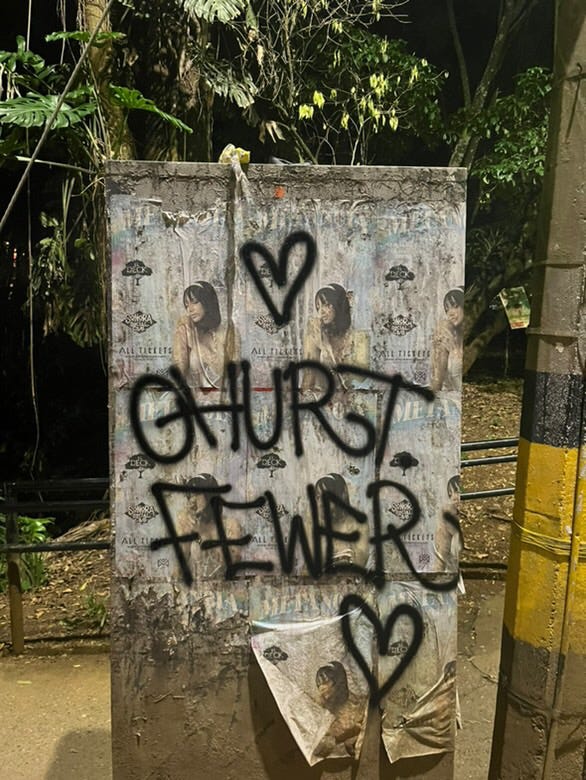
Originally bonding over skateboarding, Ohurt and her husband, who writes under the handle “Fewer,” eventually discovered a shared love of graffiti when they started dating. “We just had all the same interests, knew the same artists. So I started pushing her to get into it. Sometimes I pushed her too hard,” says Ohurt’s husband. “I had friends who’d really succeeded in the graffiti world. Not that there’s money in it. They were just very known.”
Since then, on their mission to “be seen,” the pair estimates that they’ve done over 1,000 tags throughout the city, with hundreds of throws. “Throws are harder,” says Ohurt. “It’s a lot of paint, and in Denver not every spot has longevity. All the spots are getting buffed a lot, so it makes it harder to paint or to want to paint.”
“Buffing” refers to the cleaning up of graffiti by the city or by property owners. I question Ohurt about the damage graffiti might pose to small businesses, and she explains that, among established writers, churches, schools, and small businesses are considered off-limits.
“I was out by the library, and I saw ‘Ohurt’ on a mural on the side of City O’ City,” I mention.
“That was me,” says Ohurt’s husband. “I was going over someone I didn’t like. They were already there.”
“If you’re a real writer, you won’t go out and do that stuff,” says Ohurt. “It just makes you look bad to other writers if you’re out there breaking the rules.”
“When we passed Book Mall, was that you breaking the rules?” I ask, referring to a tag the pair had pointed out earlier on the side of the Broadway bookstore’s roof.
“Not really, because it’s just on the roof and it’s small. If I had done a throw or something on the windows, writers would think it was shitty,” Ohurt replies.
“I have an interesting take on that,” Ohurt’s husband breaks in. “Hers is probably right. Like, Book Mall is cute. You’re like this liberal bookstore probably, and, like, there’s some lesbian chick working there, and I should respect that, but also they’re white, rich-ish people that have probably kicked Mexicans out of that business, or blacks out of that business, or natives out of that business or something. I think, like, fuck every business.”
“I don’t think that at all,” says Ohurt.
“It sucks because her dad owns a small business,” continues her husband. “But as a business owner, I would expect that—whether it’s a heroin needle or a tag on the side of the building.”
***
We end the night at the Evans Yard, a trainyard Ohurt and her husband describe as a legendary site for Denver graffiti, with writers coming from all over the nation to throw their name on the wall that runs beside the train tracks.
The proof is apparent. As we walk together, following the bend of cold light reflecting on the tracks, hundreds of names come into view, thousands maybe. Suddenly absorbed, Ohurt and her husband begin speaking in a private language: “There’s Hofcrew! Damn 4get just clipping Lower with the ‘G’… God, I love him. He changed the style… That’s a Voice throw! I’ve never seen a Voice throw… It’s really good. It might be from the 90s. I don’t know.”
I’m lost in the jargon, scanning the wall of names—each one a coded broadcast of a writer’s existence, a more artful “I was here” ironically inaccessible to the masses, mingling instead with other voices of the underground—communicating, competing. All of these names, all of these hours of work done in the dark at great personal risk. No profit and no popular acclaim. Just this deep need to write, to be seen. We turn around and head back to the car, but we could have kept going. The wall stretches on out of sight.
Lets gooooo!