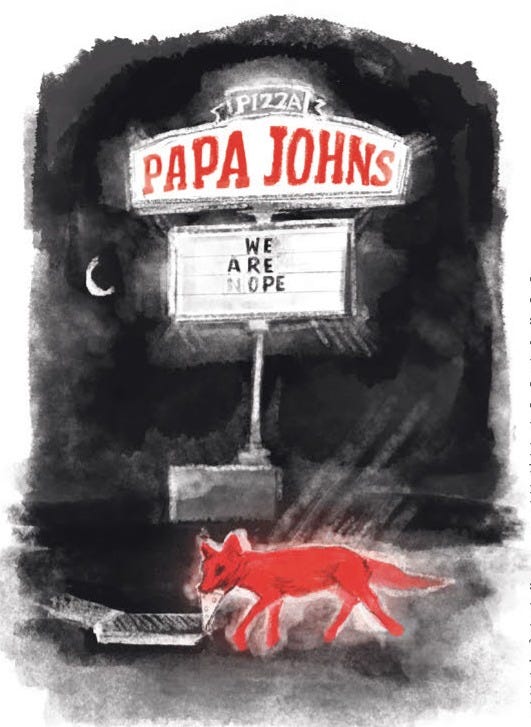
“WE ARE NOPE,” reads the sign by the Papa John’s on East Colfax. I’m stopped at a red, admiring the cheeky transposition, when a fight breaks out.
Across the street, in front of The Vixen, the slick-looking modern apartment complex that moved onto the block last year, a man in an orange shirt bangs a 2x4 against the curb and screams, calling on a man in gray.
Approaching the man in orange, crossing Downing, Gray begins to swing a flail-like weapon in front of his face. I can’t tell what it is exactly—a chain or a flexible black tube with a heavy butt end. He looks medieval—his DIY mace stirring the air in wide arcs. Orange begins to backpedal, still knocking the sidewalk with his 2x4 but with more urgency. I wonder if they picked up their weapons at the construction site next door, where more apartments are being built.
Finally, both are in striking distance—only neither man seems physically capable of hurting the other. They swing their weapons wildly, clumsily. Missing or just grazing. And both men have a limp.
Then Orange draws a pistol from his waistband and aims it right at Gray’s face. Gray hesitates, but only for a second, then takes another swipe. Orange pulls the trigger.
He pulls it again and again, but there’s no sound. And even though Gray seems to be reacting, flinching, he’s largely unfazed, still shambling forward, still swinging. Is it a pellet gun? Airsoft? Is the gun misfiring? I watch Gray joust Orange down the block. Then the light turns green, and I keep driving.
–
I’ve always wanted to talk to someone at that Papa John’s. Or Papa Johns, I should say, since the company officially dropped the apostrophe from its name in 2021 in an apparent effort to distance itself from founder John Schnatter. How bad grammar accomplishes this I have no idea—unless the corporation wants us to think of a plurality of random Papas, random Johns. Who knows how many Johns there are on Colfax.
Fortunately, the weather-beaten sign at our particular location hasn’t been updated with this change, and it may never be if the property is sold off (which could be happening very soon if my sources are correct).
I stop by on a rainy day, at odd hours. The parking lot is empty, and, after a chat, I’m finally granted an interview with one of the workers. They’d prefer to be anonymous, they tell me. Let’s call them John.
We talk outside in front of the order window. In 2021, while corporate was fretting over an apostrophe, this location was forced to stop allowing people to walk inside the store for security reasons. John points out the cameras under the eaves of the building that have been sabotaged with spray paint.
“Maybe two years ago, there was a murder right there at that bus stop,” John says. “There was a stabbing over there. There’s so much that has happened in this parking lot. Just the other day, there was a lady, an old lady. She wasn’t wearing clothes, really. She was wearing a dress, but she… she just took a shit right there on the sidewalk, man. And then she saw me recording her, and so she flashed the camera. Do you want to see the video? It’s ridiculous.”
John pulls out their phone and shows me a video of a gaunt woman dancing nude in front of the pizza establishment.
“There’s obviously drugs and crime and sex and violence around here,” John says.
“Why this spot?” I ask.
“I’m not sure why. I mean, the mix between the liquor store and Papa John’s,” they say, referring to Paul’s Liquors next door. “It turned into a marketplace for the underground. Whatever you wanted, you could get it here.”
Self-described as an “urban outdoorsman,” having spent a short time living in a tent on Denver streets, Shorts McGraw agrees it’s a rough area.
“I’ve been sucker-punched at that bus stop. I mean, no conversation, no eye contact,” he tells me. “I try to avoid it when I can.”
However, according to John and an employee over at Paul’s Liquors, things are beginning to change. There’s been more security on the block than usual. New cameras have been installed, and the police have started paying more attention to the block. And a lot of this, I learn, is the direct result of Papa’s new neighbor.
–
Across the street, inside the scented lobby of The Vixen, a high-gloss red accent wall reaches up to the ceiling—patterned with a mixture of baroque floral tiles and patches of faux crocodile leather. A young couple is finishing a tour (they seem happy), making their way through a lounge where the word “COFFEE” cascades down the wall with slanted lettering.
A promotional flyer rests on the counter, printed on luxe stock. “A vibrant addition to Denver’s cultural history with an unapologetic perspective and lifestyle,” it reads. And then below, in larger font, “UNAPOLOGETICALLY COOL,” it says, before listing some of the amenities, which include a 24-hour health club, bike storage rooms, electric vehicle charging stations, and, notably, a pool and hot tub situated on the outdoor deck, with a nice view of the city skyline and, if one chooses to approach the railing, the Papa John’s and bus stops below.
Opening last August, The Vixen began dealing with vandalism on a regular basis, according to David Thomson, vice president of client relations for Kairoi Residential, the developer behind the property. “They’d break windows, and they’d steal stuff. Maybe three weeks ago, we had someone smash a window and come in and take something out of the lobby. We had someone smash a window maybe two weeks ago, and they went in and took tools out of the open space where they were building the new coffee shop,” Thomson says, referring to the Doppio coffee shop planned for the building. He points to all of the drug-related criminal activity on the block as the source of these headaches.
“What made you want to develop that specific block then, given all those challenges?” I ask.
“It’s a good question. It’s the same thing I was asked 23 years ago: ‘Why would I want to do a race down Colfax Avenue?’” answers Thomson, who helped found the Colfax Marathon, which has indeed brought significant economic benefits to the corridor since the first event two decades ago.
“If you read about Colfax, there’s so much history about that street,” Thomson says, before outlining larger goals to revive the area. “So we took a big risk, and I hope that it’s a positive risk.”
With The Vixen’s cost of construction totaling $95 million, Kairoi couldn’t afford to take the block’s problems lying down. Thomson explains that when they first started developing the property, he’d hoped the management of the Papa John’s and some of the other businesses across the street would take a more aggressive approach to cleaning up the block, attracting new residents and shoppers to the area. But when that didn’t happen, Kairoi decided to start working with the police directly.
“We’re the one that led that conversation,” Thomson answers when I ask about increased surveillance on the block. “I started that about August of last year. Maybe July… That’s when I got the police chief to literally come in and just stand there for an hour. Just look down on it.”
The visit made an impression. As they approached The Vixen’s opening, Thomson and Kairoi cultivated a closer relationship with the police, pushing for the removal of fixtures used to hide drugs, while instituting a trespassing program that would grant the Kairoi team access to a quick line to connect with police when things went south on the block.
“We actually gave one of our units at The Vixen for 50% off to a police officer, so we have a police officer in our building,” Thomson says. “And he drives in and out with his car, and he’s in uniform, and he’s the one that’s made busts already there.”
Doing a little recon, I stand on the pool deck of The Vixen one Thursday afternoon. The leasing agent giving me the tour is suspicious. They think I’m some secret shopper working for Kairoi because of the questions I’m asking. I’m posing as someone from Thornton who wants to move into the city. It should be an easy act since I’ve been that guy before. I also have a special relationship with this block. My very first nights in Denver were spent right here over a decade ago, back when it was the Ramada, or the “Rockmada,” as Shorts McGraw calls it, remembering the raffish old bar that operated by the lounge—a local favorite known for its jukebox, $2 PBR, and Big Buck Hunter arcade cabinet.
The Vixen is a different vibe. On the pool deck, the agent and I pass a pair of young women in magnificent shape doing some weekday afternoon tanning. The tinkling of the pool’s fountain features joins the noise of Colfax traffic and the construction of additional apartments next door, a complex called Route 40, scheduled to open in 2027. “NOT JUST A PLACE TO LIVE. A PLACE TO LAUNCH,” reads its website, the copy sitting alongside a picture of a young bearded man in a slouchy beanie and an open button-down shirt, smiling as a bulldog licks his face.
I stand at the railing and look down at the street, perhaps with the same vantage the chief of police had last year. I decide to fish a little and tell the leasing agent I’m concerned about living across from the Papa John’s.
“They’re actually selling that lot,” they tell me. “Who knows what they’re going to do with it. Maybe more apartments. I know people in the area really want a parking lot.”
I feign ignorance (poorly; the leasing agent is definitely on to me), but I’d already heard about a potential sale of the Papa John’s property from real estate platform Naked Denver back in April:
“Inside sources indicate that a prominent Denver developer, active across the city and with projects in proximity, is in the process of purchasing 1111 E Colfax Ave. The site is currently home to a 1,483 square foot Papa John’s on a 15,625 square foot lot. The property, built in 1979, is owned by Anderson, John V; Archdiocese of Denver.”
My first thought was that Kairoi was the potential buyer in question—finally having the chance to pave over this blight that’s plagued the company since erecting The Vixen. However, Thomson denies this. “We would never buy it,” he says. “It’s very difficult to do a retail site there or anything. It just doesn’t work. To tear that down and do something, the financials do not work.”
I hear a similar line talking to Frank Locantore, executive director of the Colfax Ave Business Improvement District (a current Denverse sponsor, it must be noted). “Because it’s a small lot size, it just comes with more challenges. It’s just more difficult to build. I mean, you can build something there, but if you want to make your money back, you’re going to have to charge a lot for the units,” says Locantore. He compares the Papa John’s parcel to the one at Williams and Colfax, soon to be the site of affordable housing designed to attract health care employees, as outlined by developer Kentro Group.
The Papa John’s lot could have a similar fate, if the sale goes through and future developers are able to secure Low-Income Housing Tax Credits from the city. According to Locantore, whoever takes charge of the lot will still have to be prepared for the challenges of operating within the small urban space. Of course, there’s also the problem of crime in the area, but here Locantore is optimistic, citing an analytical approach to tackling the lot’s security issues, with the Archdiocese working with police to implement crime prevention through environmental design, or CPTED, ahead of the potential sale (an example would be the added fencing on the alley side of the property, which cuts off potential escape routes for criminals encountered by police).
Locantore also believes that the completion of the Bus Rapid Transit (BRT) Project will play a major role in the block’s transformation. He talks about larger goals of increasing foot traffic and attracting more active storefronts, contrasting the vision for Colfax with how the Papa John’s is working. “With the BRT, there’ll be more people that are able to access the area. The other part is around vacancies at the storefronts and activating the spaces,” he says. “Papa John’s, it’s not Voodoo Doughnuts… It’s not Doppio or Good Bones Coffee where people are walking in and out constantly. You can’t walk in. They’ve locked the door.”
It is difficult to imagine the notorious Papa John’s and its self-deprecating marquee persisting if the Colfax revival goes as planned. Standing at the intersection after my tour, I look back and forth from the pizza chain’s dumpy green-and-white awning to the giant geometric red fox face across the street. A sheet of plywood covers a presumably smashed window near the entrance. But in about five minutes, I’ll be purchasing a latte.