

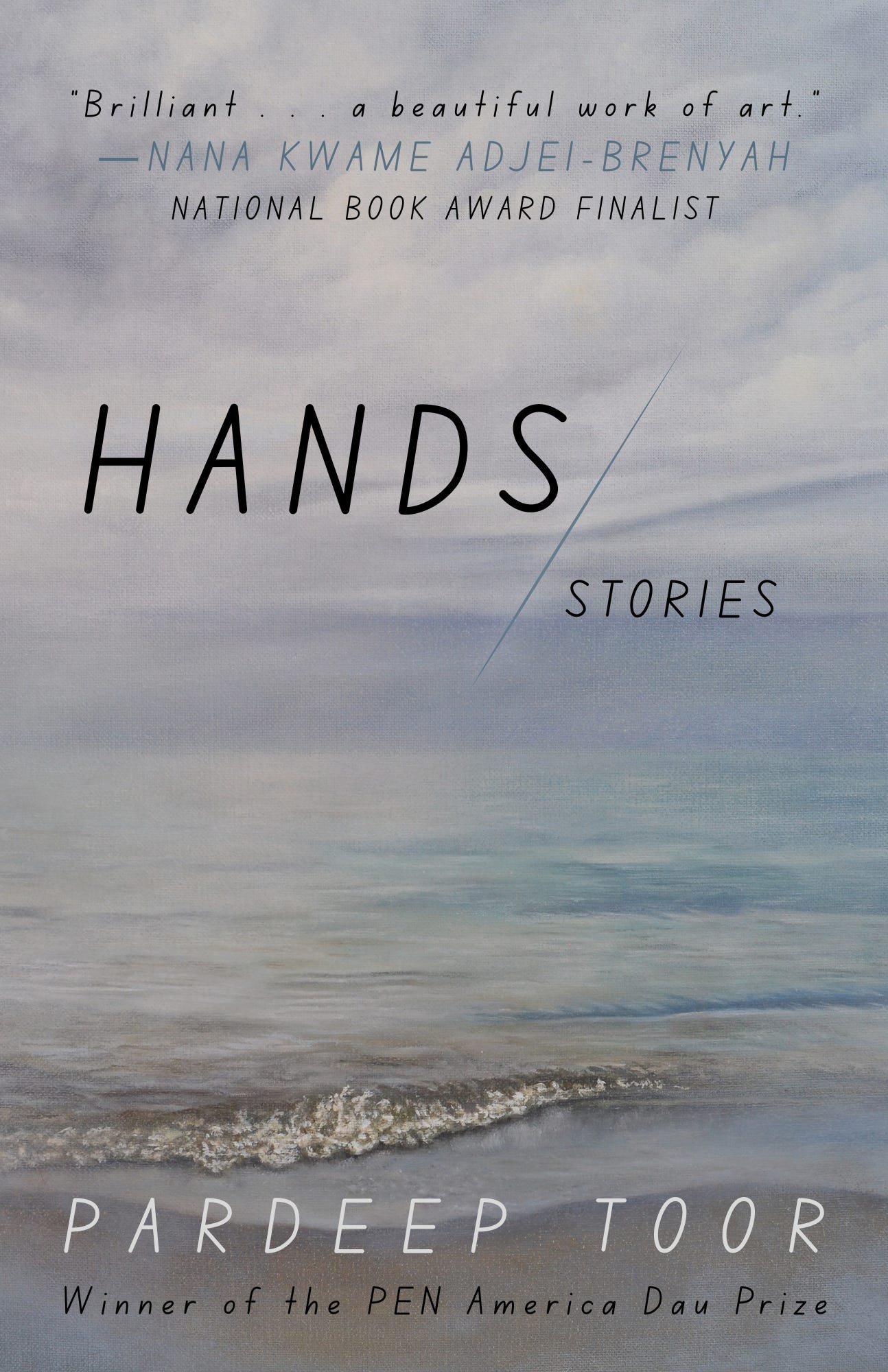
Hands, a collection of short stories by Pardeep Toor, is a compact little book well suited for vacations and leisurely reading in the park. Neither breezy nor stodgy, it should satisfy enough of the serious literary sort without putting off the casual reader looking for a few good yarns.``
Much of what makes these stories so digestible is the format. Not quite a novel, but not a set of wholly distinct stories either, Hands follows a hybrid pattern that’s begun popping up lately, in which each story can be both read in isolation and fit into a broader narrative whole. It’s very forgiving to the distracted reader and well-suited for our era.
“Gatsby,” “Dinner Party,” and “Tony & Jims” are the best of the bunch, mostly because they let the characters breathe and build out a world you can see with your eyes closed. “Taxi” is a little undercooked, and “Stranded in the Dunes” feels more like connective tissue—a prelude to “Dinner Party.”
“The Astrologer” ends the set with a sort of downbeat cymbal crash. When you finish the final line, Toor’s sense of the absurd rings clear as a bell, even if “Astrologer” also wants for development.
So a few of the stories aren’t perfect; that’s life. And Toor seems to be a good student of life. He’s delivering a perspective here, and the reader should take notice. Hands, with its working class Indian perspective, plays with the model minority albatross that flies over so many first and second-generation writers’ heads. Toor is intersectional without being smug or holy about it. His writing has a grit to it that’s been scrubbed away from many more recent works that get deemed “literary.”
Hans, the protagonist of Toor’s stories, is a squirrely fella whose bald, unselfconscious selfishness is almost beatnik, and may seem alien to modern readers conditioned to expect characters to stay within Manichean moral lanes. In this sense, Toor’s sensibilities are refreshingly old-fashioned. His choice to situate things in an unspecified pre-smartphone era does not read as some shying away from the realities of our current moment. Rather, by exploring the immigrant experience one generation back, warts and all, Toor gives the reader a living story that is not deadened and enshittified by endless layers of contemporary culture war nonsense.
Hands can feel like a dry run at times though. The closer the stories get to Hans’s erstwhile girlfriend Neelam, the more you sense there’s a novel hiding beneath blueprint gridwork. This connected-story format seems forgiving to the writer as much as the reader, with each new story acting as a hatch that lets the author escape the obligations of the novel, with its demands of continuity and extended thematic focus.
Just pick up a copy and see it all for yourself. With Hands, Toor has turned in a good book he can be proud of. Perhaps if enough people buy it, he’ll give us a great novel.