

Review: On Fire for God
Those who tuned into Charlie Kirk’s memorial with the volume on are most likely to remember the straight-forward fascism of Stephen Miller’s encomium to blood and soil. Those who watched with the volume off, however, were maybe struck by the not-quite-fascist, but nonetheless curious catharsis that rippled through the crowd. The atmosphere was distinctly Baptist, and to many it was alien.
Josiah Hesse wrestles with this reality in his new book, On Fire for God. The book has a clear agenda, to trace the cultural and economic forces that gave way to the Christian Right of today, yet its author is much more fair-minded than the thesis would suggest. Despite growing up queer in a wildly repressive Pentecostal environment, Hesse has written a searching account of his religious upbringing in Iowa, where the people are well-meaning, but their methods of moral and spiritual instruction, glossolalic or otherwise, can be ruinous.
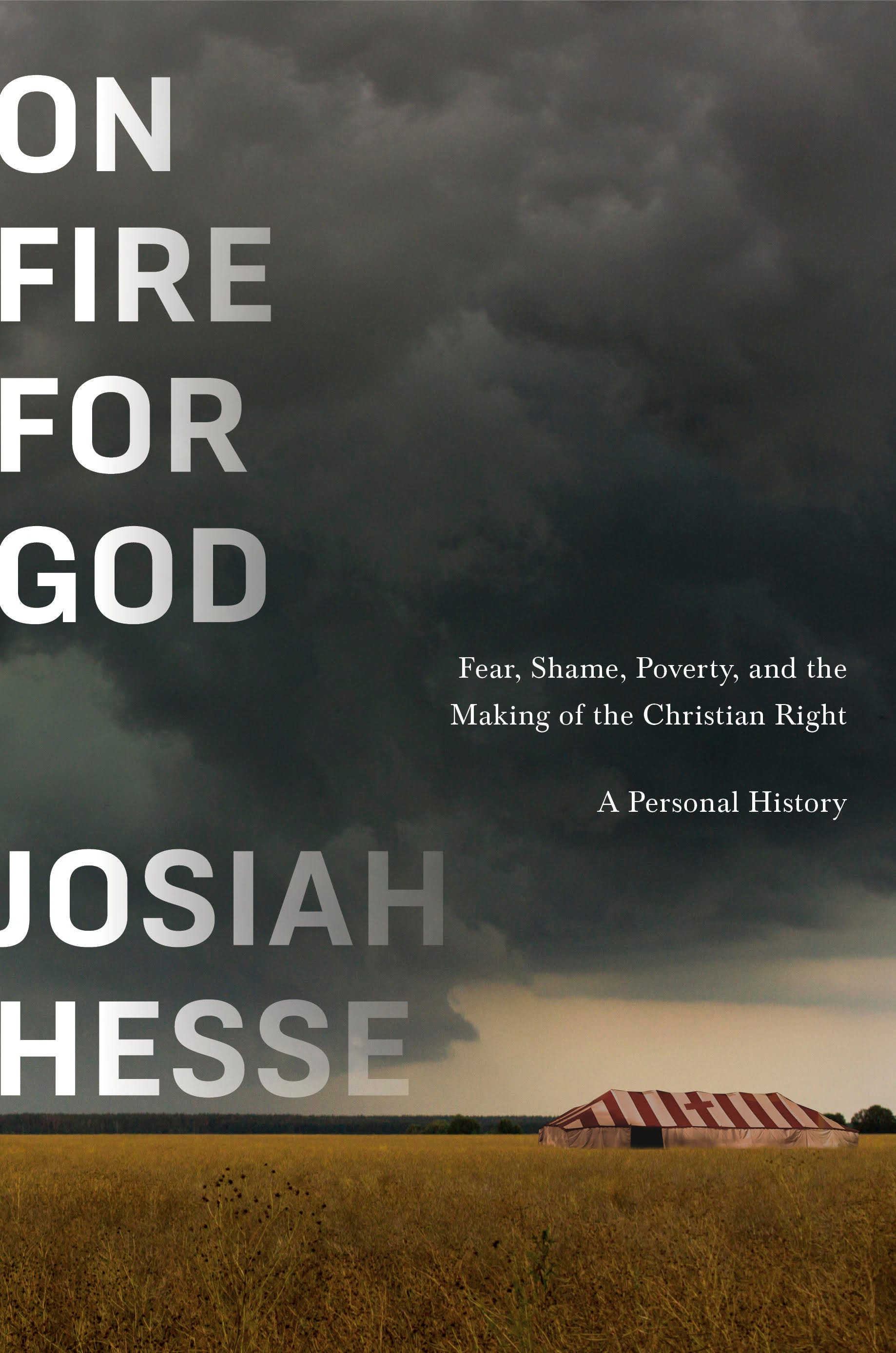
A solid portion of the book explores the ruin, tallying up anecdotes of every flavor of hypocrisy and self-abnegation imaginable from Hesse’s youth and young adulthood. Some stories are hard to read, while others are darkly hilarious (Hesse’s dad was a wild dude), and though it may sometimes feel a little voyeuristic, the reader never senses that Hesse is pinning his family, friends, and neighbors to the cork like some exotic moth destined for secular taxonomy. At worst, you might call it auto-therapy, but Hesse is clearly withholding certain stories, and never devolves into outright score-settling. Despite being an “exvangelist,” Hesse has not lost the Christian impulse towards grace when dealing with his subjects.
Hesse weaves his personal story into the broader narrative of the Christian Right, all while staying focused on his hometown of Mason City, a small, erstwhile farming community that punches above its weight in cultural relevance. He traces the blast radius of the economic bomb that was the Iowa Farmers Crisis, making a good case that the dispossessed farmers were being lunched on by wolfish pastors who demanded “seed faith,” or money beyond the tithe, a sort of holy insurance policy that looks an awful lot like Catholic indulgences if you squint. Amid all this, Hesse pulls back the curtain on a strange perpetual motion machine of grievance and despair that has served as a formidable engine of right-wing politics over the past half-century, demonstrating that the gospel of prosperity invariably yields to an unforgiving politics of austerity.
The writing stays pretty wet throughout, and despite its often weighty content, the book never feels too heavy to pick up. The parallels he draws between the huckster antihero of The Music Man, a canonical American play set in a lightly fictionalized Mason City, and the avaricious reverends that prowl its streets today is a narrative stroke of genius that serves his thesis well. He sometimes gets a little carried away, seemingly pulling out a Music Man quote at the drop of every pork pie hat, but after reading this account, it’s the sort of zeal you can forgive.