

Editor’s Note: This investigative story from our third issue was previously behind a paywall. We’re temporarily unlocking this piece for all of our newsletter recipients for free, but we hope you’ll subscribe to support our grassroots, local journalism efforts, if you haven’t already. We publish longform deepdives on local topics, along with fantastic original artwork and more. You can sign up here. And thank you to all of our current subscribers! We’ll be announcing our next subscriber-exclusive event soon.
Since this story was published, its subject, Denver’s own Nyaruchuu, has put up another billboard farther south on Broadway (right by Monolith Brewing and Baked in Denver, if you know the area).
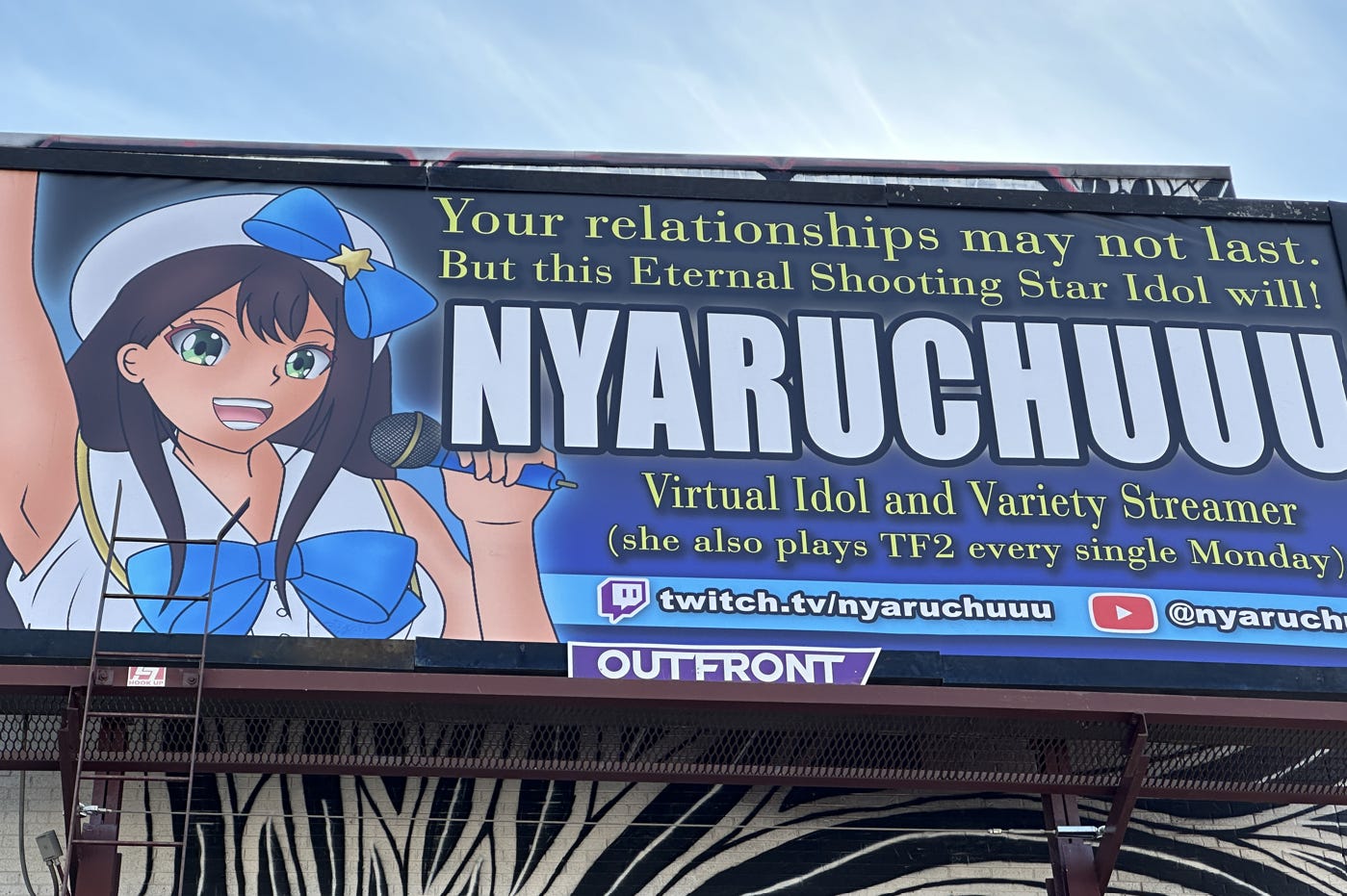
Last year’s billboard (located at Broadway and 10th):
This year’s billboard (located at 1248 S Broadway):
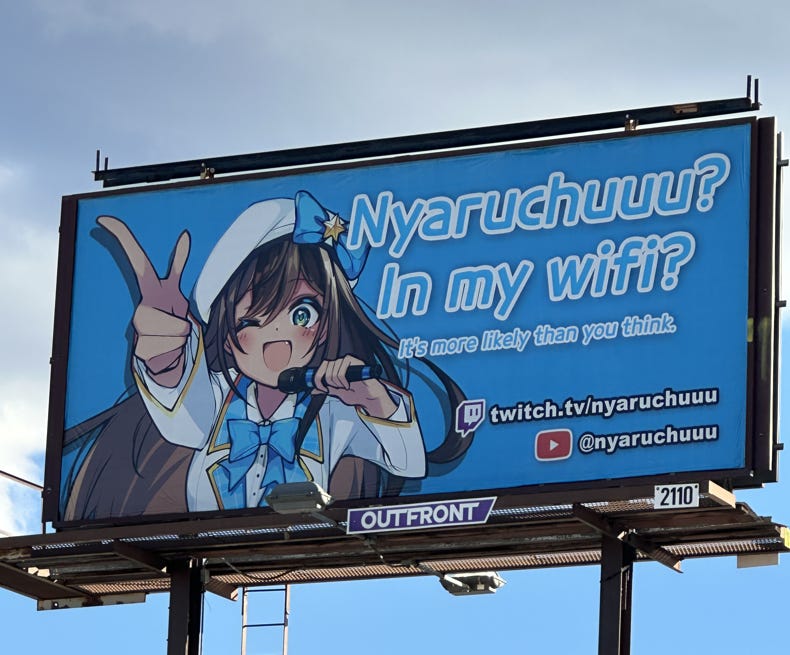
It’s possible that we’ll continue to see a Nyaruchuu billboard pop up somewhere in Denver around this same time every year. If you want to understand why, and if you want to learn about the global industry this character is part of, read on.
Thank you!
-Paul M. French, Editor
The Girl on the Broadway Billboard
Examining a billion-dollar industry
and its envoy in Denver
I’m trying to steal a few hours at a coffee shop in Cap Hill. I just want to get some writing done, but all I can think about is the girl a few blocks away. Her name is Nyaruchuu, and she’s a cartoon.
“Your relationships may not last. But this Eternal Shooting Star Idol will!” reads the text beside her giant jellied eyes. At the bottom of the graphic, Nyaruchuu’s social media handles are listed. At Broadway and 10th, the billboard occupies prime real estate for advertising—a high-traffic intersection catching southbound commuters heading home from the metro. And, later, when I call the person responsible for coordinating the purchase, I learn it was $4,500 for the spot and that it wasn’t the first. The original billboard was up north on Walnut Street, and it was $2,000. “Alone? Good,” the previous iteration read. Both were birthday presents for the girl whose age is listed online as “Forever 18.”
I have no idea what I’m about to get into. I scroll through Nyaruchuu’s Twitter page and find pictures of men standing in front of the billboard on Broadway waving American flags superimposed with images of Nyaruchuu. I see ads for body pillows and mousepads with half-naked pictures of Nyaruchuu. There are Nyaruchuu dolls being held by a group of men at the top of Pikes Peak, then in front of Casa Bonita by an anonymous hand. On YouTube, Nyaruchuu is playing video games, commenting on movies, carving pumpkins. There’s a video where the camera looks up her skirt into a mass of black pixels. There’s a video where she jokes about peeing herself on camera, then a video where she jokes about drinking her own pee. I watch a video of her playing a porn game where, in order to watch other cartoon women have sex, the player has to line up shiny gummy-like blocks. As with Nyaruchuu and her world, the game is full of bright colors and soft edges, ostensibly childlike until the player achieves a high enough score of “Affection” points for the women to take off their clothes. When this happens, Nyaruchuu pulls up a “Censored” graphic. YouTube doesn’t allow certain types of adult content on its platform. The viewers in the chat seem to be aware of this. “Seggs comes after this so get the censor bar ready,” one of them says—with “seggs” being a spelling used by some people online to prevent videos from being flagged as adult content.
Nyaruchuu doesn’t have too many viewers—often fewer than 100 at a time during her livestreams—but they’re extremely devoted. As expensive as her recent forays into physical advertising have been, if we’re to believe Nyaruchuu (whom I eventually interviewed), she didn’t pay for any of it. Her fans did.
Nyaruchuu is a virtual tuber or Vtuber. It’s a form of video entertainment that began in Japan but that, in recent years, has begun to gain traction in the U.S. Vtubing combines the appeal of livestreaming with certain offshoots of anime fandom. Vtubers almost never show their real face, choosing instead to voice animated characters, which they use for anonymity, among other things.
Often performing commentary for video games or movies—with their character in the foreground like a TV news anchor—Vtubers primarily appear as teenage girls, complete with articulated features. For instance, when I speak with Nyaruchuu, her avatar’s mouth moves and her breasts wobble in exaggerated fashion, a gimmick known in the online anime and gaming community as “jiggle physics.”
What began as a niche genre of entertainment in Japan has grown into a billion-dollar industry spanning multiple continents. According to a disclosure submitted to the Tokyo Stock Exchange, in 2021, when IRIAM Inc., a company Nyaruchuu works with as a “founding streamer,” underwent a stock acquisition by DeNA Co., Ltd, its total assets for fiscal year 2020 amounted to about 1.1 billion yen, roughly the equivalent of 10.5 million dollars. And IRIAM is just one company in a multifaceted industry. Cover Corp, one of the larger entities in the V-tubing business, has a market cap of $1.07 billion as this is written. Touring the Cover Corp website, I find videos of anime girls in short skirts dancing alongside corporate metrics outlining consumer reach and engagement: “Total media reach of advertising projects: 80 billion. Total views on YouTube: 14 billion. Number of V-tubers with 1 million subscribers: 38.”
The most popular streamer for Cover Corp is Gawr Gura, with 4.5 million subscribers on YouTube alone. On July 5, 2024, during a revealing collision of Vtubing with mainstream culture, Gura sang “Take Me Out to the Ballgame” at Dodgers Stadium (on the jumbotron). There was also a commercial drone show put on by Cover Corp, with its platform Hololive’s brand spelled out in lights for fans of the soon-to-be World Series winners. The Vtuber received a largely warm reception from the local press, with Bill Shaikin writing a column for the LA Times speculating about how Gura’s appearance could draw younger audiences into Dodgers fandom. There was not much in the way of exploring Gura’s content though.
When I search “Gawr Gura” on YouTube, the second recommended video is titled “Gura reveals her REAL age height and weight to EVERYONE.” In the video, Gura—who resembles a young child—sways in front of the camera in a bikini top, with what seem to be thong straps sticking out of her shorts. She makes a joke about the small size of her breasts and then says that she’s technically only four years old (since that’s how long she’s been working for Cover Corp’s Hololive platform). When I look through Gura’s most popular videos on her channel, there’s a short clip of her in the same outfit on a beach. “Hey, behind you,” she says. The camera pans to her from a much taller POV. “Check this out,” she says, swaying her hips and spinning around. “You think I’m cute? I know, right.” She spins around again. Then she gets dizzy and falls onto the sand. “Everything’s all spinny now,” she says, laughing and looking up at the audience, with the perspective standing right above her, looking down.
I start scrolling through the list of top executives on Cover Corp’s company info page. One hundred percent of them are men. I keep scrolling down until I hit the very bottom of the site, where I spot a curiously labeled link called “Request to Minors.”
The “Request to Minors” link takes me to a page containing a list of numbered items. Apparently, as its title conveys, this page is directed at minors who have apparently stumbled across some of Cover Corp’s content. “We ask that you observe the following rules to ensure the safety and security of yourself as well as others,” the copy reads. The list is composed of three rules that Cover Corp is urging all of the underage visitors to its corporate website to follow: “1. Obtain parental consent prior to the use of paid content; 2. Please confirm your payment method prior to spending; 3. If you have purchased or used any product by mistake, please get in contact with a representative as soon as possible.”
“In particular, please do not use a parent’s credit card without permission,” exhorts Cover Corp under item #2.
What constitutes “paid content” varies among Vtubing streamers and platforms. Fans can shell out for merch like body pillows, which are popular in this community and typically depict characters modeling from the front and the back in seductive poses. However, some of the most common transactions come in the form of Super Chats, where viewers can pay to have their comments or questions addressed by a Vtuber during a livestream. Watching a clip of a Gawr Gura livestream, you can see fans spending hundreds or even thousands of dollars in minutes just to have her read their comments. (Gura’s paying fans are called “shrimps,” a play on the word “simps,” which is an internet term often applied to men who pay large sums to women online in the hopes of buying their affection.)
Going back to Denver’s Nyaruchuu and one of her streams, it becomes clear just how generous some of this local Vtuber’s followers are with their money. Compared to Gura, Nyaruchuu is a small fish, with only 13,000 subscribers on YouTube. However, in a drive to buy Christmas presents for an anime fan writing to Santa, Nyaruchuu’s followers donate over $400 in under 10 minutes. The live viewer count never gets above 50 while I’m watching.
It’s difficult for me to determine who exactly these viewers are though. YouTube does not reveal the precise demographic information for channel audiences to prying eyes. And when I click on the profiles in the live chat, I’m not given an option to view a profile or any other form of identifying information.
“How old are your viewers?” I ask Nyaruchuu, or “Nyaru” for short.
“They’re 25+, mostly,” she says, “because supporting a streamer can be a really, I don’t want to say expensive hobby, but if you do want to support the streamer, it does require a lot of money.”
While researching the billboard and the Vtubing industry, I’d reached out to see if Nyaru would be willing to speak with me. I’d never done an interview like this one before. I’m staring at my laptop, interacting with this anime girl one-on-one in a format identical to how her fans see her. It’s the first time I’ve ever spoken to a cartoon.
“The big Vtubing boom here in the West, or like in America, kind of started around the COVID 2020 times,” she says, “when we just didn’t really have much to do and we really wanted to just kill time. A lot of people just decided to hire or commission an artist to create a model for them. And then they just started streaming their favorite video games or just doing different types of content.”
Immediately, she strikes me as affable, polite, conversationally gifted—in possession of all the traits desirable in someone who makes money interacting with people in front of a camera. In short, Nyaru is a professional.
She goes on to tell me all about her trade, and her decision to connect with people at the local level here in Denver. Nyaru has made more of an effort to direct her content toward locals than other Vtubers—with a recent video highlighting a trip to Casa Bonita and, of course, her name on a billboard. The word “community” comes up several times, inflected with the extra warmth and positivity the term has attracted in recent years, as numerous scholars speculate on the risks of loneliness and social isolation inherent in a culture that is increasingly online.
And it’s true that as more people’s social lives have migrated into the virtual world so too have their romantic lives. For instance, apps for virtual partners such as Replika have become more popular in recent years, often containing anime-style girlfriends or boyfriends that use AI to gather data about their users in order to personalize responses.
The increasing use of these 2D companions has fueled discussion about the hazards of parasocial relationships online—with “parasocial” referring to the one-sided relationships audiences can develop with mass media performers.
People have been known to develop erotic fixations on cartoon characters, especially in the anime community, which is broaching the mainstream. According to the pop culture news site Polygon, 44% of anime fans say they have had a crush on an anime character at some point.
Whether parasocial relationships are directed toward celebrities or anime characters, many psychologists and critics have been quick to point out the dangers of this behavior, which they say can reinforce feelings of isolation and loneliness, while interfering with real-life two-way relationships (e.g., friends, family, and genuine romantic partners). Earlier in 2024, a 14-year-old boy committed suicide after he started interacting with an AI companion. His mother has since sued the company responsible for the program, alleging in court documents that her son fell in love with the character and that it effectively convinced him to kill himself. The company has “targeted the most vulnerable members of society—our children,” said the mother.
It’s difficult to determine the average age of the American Vtubing audience, partly due to legal research limitations for people under 18. Nyaru claims that her audience is composed of people 25 and up. However, according to data published in 2024 by the Yano Research Institute in Japan, among people aged 15-44, the largest share of Vtuber fans belonged to boys aged 15-19. The share of fans declined as survey participants aged, and there was a significant difference between genders, with the smallest portion going to women aged 40-44, at only 1%.
Here it’s worth pointing out that the vast majority of Vtubing characters are female. They often appear as blushing teenage girls, and some of the more popular Vtubing videos on YouTube involve these characters discussing sexuality with their audience in the form of fetishes or erotic subject matter. Looking at Nyaru’s channel, if we filter its archive of videos by popularity, we can find multiple examples, including a video called “Let’s Just Pretend,” where Nyaru describes fellatio in graphic detail.
There’s even a popular video on Nyaru’s channel titled “How VTubers Groom Their Audience.” In this video, Nyaru compares herself to the character Dennis from the TV show “It’s Always Sunny in Philadelphia,” claiming that she uses the “D.E.N.N.I.S. System” every time she streams. For those unfamiliar with “Sunny,” the D.E.N.N.I.S. System is the character’s way of ensnaring and emotionally abusing sexual partners by D. – Demonstrating value, E. – Engaging physically, N. – Nurturing dependence, N. – Neglecting emotionally, I – Inspiring hope, and S – Separating entirely.
“Separate entirely is when I end stream. See! I D.E.N.N.I.S. Systemed you guys every single stream,” Nyaru says, laughing. “It works! It just works!”
The language employed by Nyaru’s billboards also could be interpreted as a cheeky reference to the parasocial bond Vtubing audiences develop—with the first tagline being “Alone? Good,” and the second being “Your relationship may not last. But this Eternal Shooting Star Idol will.”
However, during my interview with Nyaru, she claims that these lines are more of a nod toward the problem, and that she doesn’t encourage that kind of relationship with her fans. “It’s more like, hey, we’re just all here to hang out. Have a good time, you know. Become friends with one another,” she says. “Usually, for both fans and Vtubers, they don’t really go into Vtubing to look for relationships or even replacements for relationships. Those situations of course still do exist. But I would say a majority of [viewers] are not looking for anything like that.”
On the other hand, according to Nyaru and “Xeon,” the fan who claims to have coordinated the billboard deals, Nyaru’s viewers have purchased advertising on her behalf totaling about $6,500. In both cases, the billboards were bought by the fans as “birthday presents,” signaling a more intimate connection with the character. And again, there’s Nyaru’s content. Right now, I’m looking at yet another promo for a porn game playthrough on her page. There are hearts floating in Nyaru’s eyes. Her mouth hangs open. “We’re gonna have a WHITE Christmas,” she says.
And if Vtubing really isn’t all about nurturing parasocial relationships and is more about 25+ aged members of a community just hanging out, as Nyaru claims, I wonder why it’s so profitable. If only the multitudes of struggling small businesses could unlock the inscrutable mysteries behind this industry’s financial boom. What, I wonder, is making these particular viewers so committed, so magnanimous to our new anime girl icons?
Big tech players like YouTube (owned by Google) and Twitch (owned by Amazon) certainly seem to understand and are reaping the benefits. As for me, I’m sure I can only speculate. But maybe the answer is obvious to anyone who really looks.